BASIC OF HINDUSTANI CLASSICAL MUSIC
Hindustani Classical Music is a rich and ancient musical tradition of North India, deeply rooted in spiritual, emotional, and artistic expression. It is based on ragas (melodic frameworks) and talas (rhythmic cycles), forming the foundation of improvisation and composition.
Key Elements:
Raga (Melody):
A raga is a set of specific notes (swaras) arranged in a way that evokes a particular mood or emotion.
Each raga follows a specific time of day or season for its performance.
Example: Raga Yaman (Evening), Raga Bhairav (Morning).
Tala (Rhythm):
Tala refers to rhythmic cycles that structure a composition.
Common talas include Teentaal (16 beats), Jhaptal (10 beats), and Ektaal (12 beats).
Swara (Notes):
Hindustani music has seven basic notes (Sa, Re, Ga, Ma, Pa, Dha, Ni) with variations called shuddha (natural), komal (flat), and tivra (sharp).
Alap & Bandish:
Alap: The slow, improvised introduction of a raga without rhythm.
Bandish: A fixed composition set to a tala.
Gharanas (Styles of Music):
Different schools of music (Gharanas) have unique styles of singing and playing instruments.
Examples: Gwalior Gharana, Kirana Gharana, Patiala Gharana.
Vocal and Instrumental Forms:
Vocal: Khayal, Dhrupad, Thumri, Tarana, Tappa, Bhajan.
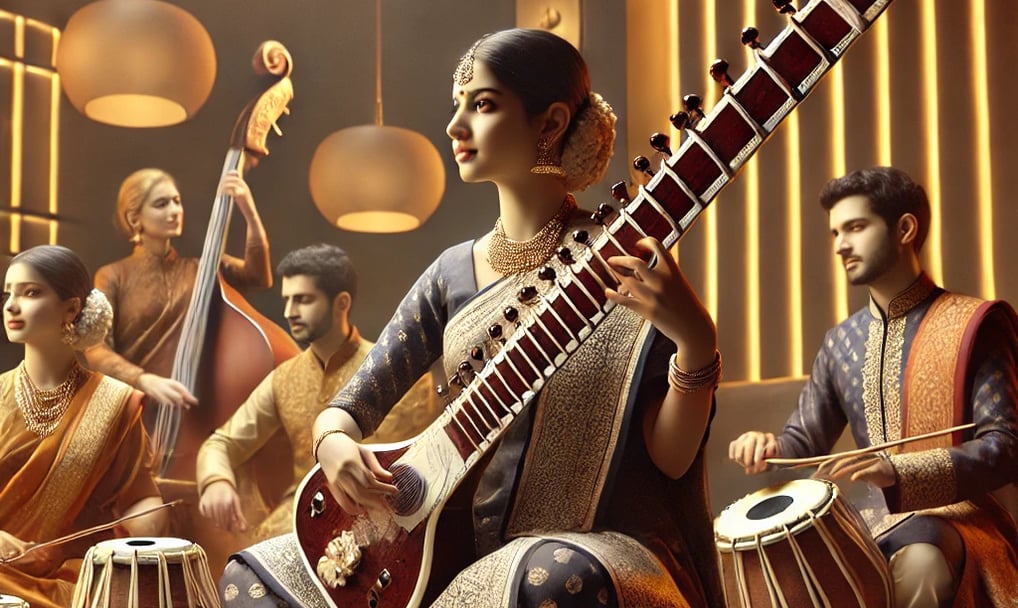
Instrumental: Sitar, Sarod, Tabla, Santoor, Flute.
Hindustani Classical Music is deeply meditative, expressive, and improvisational, making it a unique art form that continues to evolve while preserving its rich traditions.